
Montgomery 2320 Business Development Services LLC | June 19th, 2026
The business environment of 2026 is fundamentally different from the environment most companies operated in just a decade ago. Supply chain disruptions, labor shortages, inflationary pressures, geopolitical uncertainty, artificial intelligence, automation, and changing consumer expectations have exposed a critical weakness in many organizations: dependence on external systems they do not control.
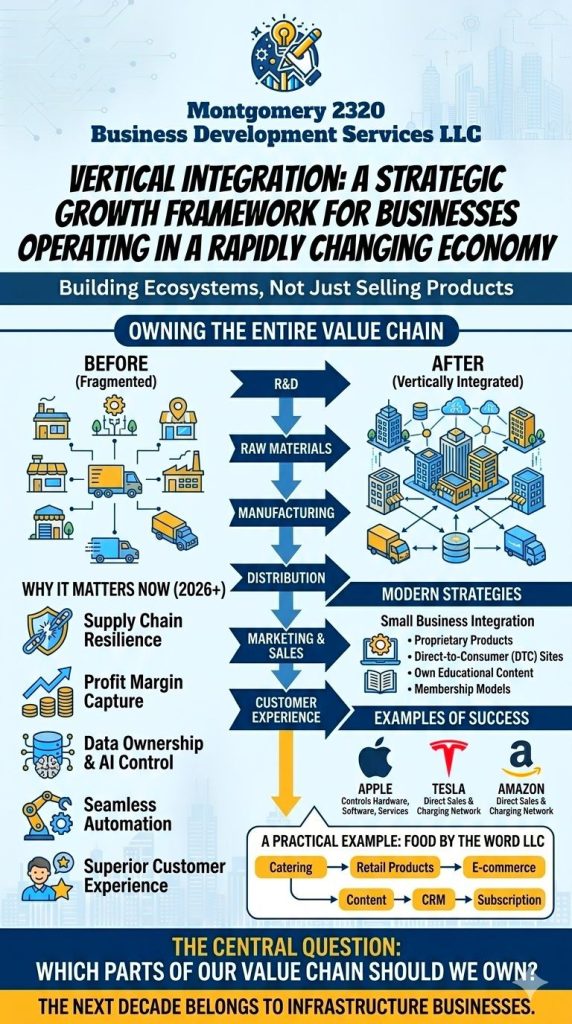
As a result, vertical integration has moved from being a strategy used primarily by large corporations to becoming a competitive necessity for businesses seeking long-term sustainability, profitability, and scalability.
What Is Vertical Integration?
Vertical integration is the process of expanding ownership or control over multiple stages of a company’s value chain rather than relying exclusively on third-party providers.
In simple terms, a business moves beyond selling a product or service and begins controlling the systems that produce, distribute, market, support, or deliver that product or service.
Instead of operating as a single point within a supply chain, the company becomes responsible for multiple stages of the process.
Traditional Example
A restaurant traditionally:
• Purchases ingredients from distributors
• Uses third-party marketing companies
• Relies on delivery platforms
• Depends on external training providers
A vertically integrated restaurant might:
• Manufacture proprietary seasonings
• Operate its own e-commerce platform
• Develop its own training programs
• Maintain direct customer databases
• Manage portions of its own logistics and fulfillment
Each additional layer increases control while reducing dependence on outside organizations.
The Two Types of Vertical Integration
Backward Integration
Backward integration occurs when a company gains control over suppliers or production resources.
Examples include:
• A bakery purchasing a flour mill
• A retailer launching private-label products
• A food distributor creating its own manufacturing operation
• A logistics company developing proprietary software systems
The objective is to control costs, quality, and supply continuity.
Forward Integration
Forward integration occurs when a company gains control over distribution and customer access.
Examples include:
• Manufacturers selling directly to consumers
• Farmers opening retail stores
• Consultants creating online education platforms
• Product companies launching subscription services
The objective is to own customer relationships and maximize profit margins.
───
Why Vertical Integration Matters More Today Than Ever
1. Supply Chain Volatility Is the New Normal
For decades, businesses optimized for efficiency.
Today, successful businesses optimize for resilience.
The COVID-era disruptions demonstrated how quickly a company can lose access to inventory, transportation, labor, and production capacity.
Organizations that controlled more of their supply chain recovered faster because they had fewer external dependencies.
The future belongs to businesses that can continue operating when external systems fail.
2. Profit Margins Are Being Compressed
Every intermediary takes a percentage of value.
Manufacturers. Distributors. Advertising platforms. Marketplaces. Payment processors. Delivery services.
When businesses depend entirely on third parties, margins become increasingly compressed.
Vertical integration allows organizations to capture more of the value they create.
Instead of earning profit from a single activity, they generate revenue from multiple points throughout the value chain.
3. Data Has Become a Strategic Asset
Many businesses still allow third-party platforms to own their customer relationships.
When a customer purchases through a marketplace, social media platform, or delivery application, valuable customer intelligence often remains with that platform.
Vertically integrated organizations increasingly:
• Build direct sales channels
• Own customer databases
• Control analytics
• Capture behavioral insights
• Develop predictive business intelligence
In the AI era, the organization that owns the data often gains the greatest competitive advantage.
4. Automation Favors Integrated Systems
Artificial intelligence and automation perform best when systems communicate seamlessly.
A business operating disconnected software, vendors, and service providers often experiences data fragmentation.
Vertically integrated organizations can create unified ecosystems where:
• Sales data drives inventory decisions
• Inventory data triggers procurement
• Procurement data informs forecasting
• Forecasting data supports financial planning
This creates a self-improving operational system that becomes increasingly efficient over time.
5. Customer Experience Has Become a Competitive Advantage
Consumers increasingly value consistency, speed, transparency, and reliability.
Businesses controlling multiple stages of customer interaction can deliver a superior experience because fewer external organizations influence outcomes.
The result is:
• Better customer retention
• Stronger brand loyalty
• Increased recurring revenue
• Higher lifetime customer value
───
Modern Examples of Vertical Integration
Some of the world’s most successful companies have embraced vertical integration as a core strategy.
• Apple Inc.- controls hardware, software, services, and retail distribution.
• Tesla Inc. – controls vehicle manufacturing, software, charging infrastructure, and direct sales.
• Amazon – controls fulfillment centers, transportation networks, cloud infrastructure, marketplaces, and media assets.
Their success is not simply about size.
It is about controlling strategic infrastructure.
───
Vertical Integration for Small Businesses
Many entrepreneurs incorrectly assume vertical integration is only for billion-dollar corporations.
In reality, modern technology has dramatically lowered barriers to entry.
A small business can vertically integrate by:
• Developing proprietary products
• Building direct-to-consumer websites
• Creating educational content
• Launching membership communities
• Managing digital marketing internally
• Building subscription-based revenue models
• Using AI-powered business intelligence tools
• Creating strategic partnerships that reduce dependency on intermediaries
Vertical integration is not about owning everything.
It is about controlling the most critical components of value creation.
───
A Practical Example: Food By The Word LLC
Food By The Word LLC provides a practical example of progressive vertical integration.
The company evolved from a catering operation into a diversified enterprise that now includes:
• Retail product sales
• E-commerce infrastructure
• Content creation
• Educational resources
• Product branding
• Customer relationship management
• Direct fulfillment
• Search engine optimization
• Subscription-based business relationships
Rather than relying exclusively on external distribution channels, the organization has developed multiple revenue-producing assets that work together within a unified business ecosystem.
This approach increases operational resilience while creating opportunities for scalable growth.
───
The Future of Vertical Integration
The next decade will likely separate businesses into two categories:
Transaction Businesses
Organizations that sell products or services but control very little of the value chain.
These businesses remain vulnerable to:
• Market disruptions
• Vendor price increases
• Platform policy changes
• Competitive pressure
Infrastructure Businesses
Organizations that own critical systems within their value chain.
These businesses gain:
• Greater pricing power
• Stronger margins
• Better customer retention
• Improved operational resilience
• Enhanced data ownership
• Greater scalability
The companies that thrive in the coming decade will not simply sell products.
They will build ecosystems.
───
Conclusion
Vertical integration is no longer merely a growth strategy. It is increasingly becoming a risk management strategy, a profitability strategy, and a competitive advantage strategy.
In an environment shaped by artificial intelligence, supply chain volatility, economic uncertainty, and accelerating technological change, businesses that control more of their operational infrastructure are better positioned to adapt, scale, and endure.
The central question business leaders should be asking is no longer:
“What business are we in?”
The more important question is:
“Which parts of our value chain should we own?”
The answer to that question may determine which organizations lead their industries over the next decade and which struggle to remain relevant.