
Tag: Technology

  • Vertical Integration: A Strategic Growth Framework for Businesses Operating in a Rapidly Changing Economy

    Montgomery 2320 Business Development Services LLC | June 19th, 2026


    The business environment of 2026 is fundamentally different from the environment most companies operated in just a decade ago. Supply chain disruptions, labor shortages, inflationary pressures, geopolitical uncertainty, artificial intelligence, automation, and changing consumer expectations have exposed a critical weakness in many organizations: dependence on external systems they do not control.
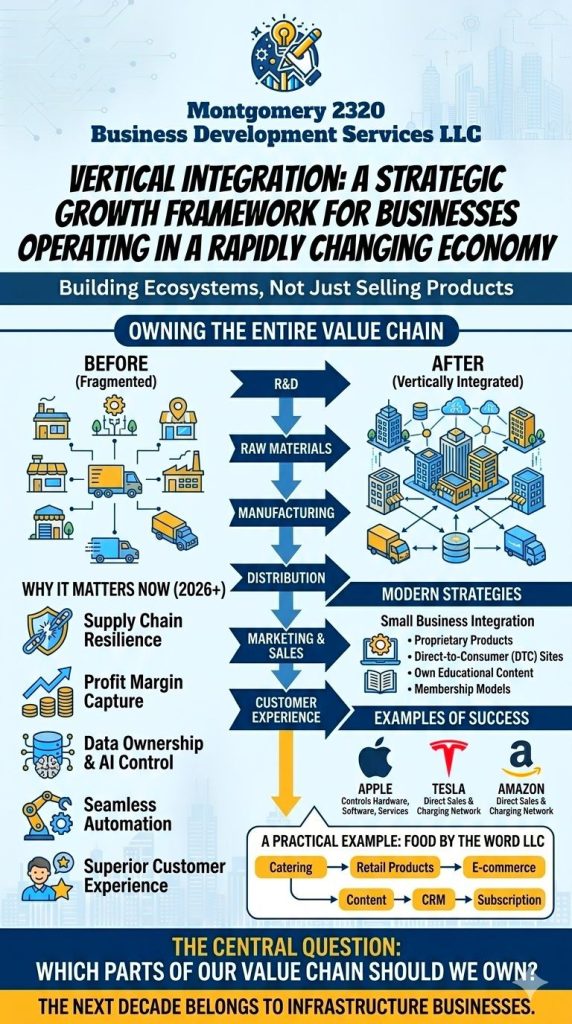
    Vertical Integration Framework


    As a result, vertical integration has moved from being a strategy used primarily by large corporations to becoming a competitive necessity for businesses seeking long-term sustainability, profitability, and scalability.
    What Is Vertical Integration?
    Vertical integration is the process of expanding ownership or control over multiple stages of a company’s value chain rather than relying exclusively on third-party providers.


    In simple terms, a business moves beyond selling a product or service and begins controlling the systems that produce, distribute, market, support, or deliver that product or service.


    Instead of operating as a single point within a supply chain, the company becomes responsible for multiple stages of the process.


    Traditional Example
    A restaurant traditionally:
    • Purchases ingredients from distributors
    • Uses third-party marketing companies
    • Relies on delivery platforms
    • Depends on external training providers


    A vertically integrated restaurant might:
    • Manufacture proprietary seasonings
    • Operate its own e-commerce platform
    • Develop its own training programs
    • Maintain direct customer databases
    • Manage portions of its own logistics and fulfillment


    Each additional layer increases control while reducing dependence on outside organizations.


    The Two Types of Vertical Integration
    Backward Integration
    Backward integration occurs when a company gains control over suppliers or production resources.


    Examples include:
    • A bakery purchasing a flour mill
    • A retailer launching private-label products
    • A food distributor creating its own manufacturing operation
    • A logistics company developing proprietary software systems


    The objective is to control costs, quality, and supply continuity.
    Forward Integration
    Forward integration occurs when a company gains control over distribution and customer access.


    Examples include:
    • Manufacturers selling directly to consumers
    • Farmers opening retail stores
    • Consultants creating online education platforms
    • Product companies launching subscription services


    The objective is to own customer relationships and maximize profit margins.

    ───

    Why Vertical Integration Matters More Today Than Ever


    1. Supply Chain Volatility Is the New Normal
    For decades, businesses optimized for efficiency.


    Today, successful businesses optimize for resilience.


    The COVID-era disruptions demonstrated how quickly a company can lose access to inventory, transportation, labor, and production capacity.


    Organizations that controlled more of their supply chain recovered faster because they had fewer external dependencies.
    The future belongs to businesses that can continue operating when external systems fail.


    2. Profit Margins Are Being Compressed
    Every intermediary takes a percentage of value.


    Manufacturers. Distributors. Advertising platforms. Marketplaces. Payment processors. Delivery services.
    When businesses depend entirely on third parties, margins become increasingly compressed.


    Vertical integration allows organizations to capture more of the value they create.


    Instead of earning profit from a single activity, they generate revenue from multiple points throughout the value chain.


    3. Data Has Become a Strategic Asset
    Many businesses still allow third-party platforms to own their customer relationships.


    When a customer purchases through a marketplace, social media platform, or delivery application, valuable customer intelligence often remains with that platform.


    Vertically integrated organizations increasingly:
    • Build direct sales channels
    • Own customer databases
    • Control analytics
    • Capture behavioral insights
    • Develop predictive business intelligence


    In the AI era, the organization that owns the data often gains the greatest competitive advantage.


    4. Automation Favors Integrated Systems


    Artificial intelligence and automation perform best when systems communicate seamlessly.


    A business operating disconnected software, vendors, and service providers often experiences data fragmentation.


    Vertically integrated organizations can create unified ecosystems where:
    • Sales data drives inventory decisions
    • Inventory data triggers procurement
    • Procurement data informs forecasting
    • Forecasting data supports financial planning


    This creates a self-improving operational system that becomes increasingly efficient over time.


    5. Customer Experience Has Become a Competitive Advantage


    Consumers increasingly value consistency, speed, transparency, and reliability.


    Businesses controlling multiple stages of customer interaction can deliver a superior experience because fewer external organizations influence outcomes.


    The result is:
    • Better customer retention
    • Stronger brand loyalty
    • Increased recurring revenue
    • Higher lifetime customer value

    ───

    Modern Examples of Vertical Integration
    Some of the world’s most successful companies have embraced vertical integration as a core strategy.


    • Apple Inc.- controls hardware, software, services, and retail distribution.
    • Tesla Inc. – controls vehicle manufacturing, software, charging infrastructure, and direct sales.
    •  Amazon – controls fulfillment centers, transportation networks, cloud infrastructure, marketplaces, and media assets.


    Their success is not simply about size.
    It is about controlling strategic infrastructure.

    ───

    Vertical Integration for Small Businesses
    Many entrepreneurs incorrectly assume vertical integration is only for billion-dollar corporations.


    In reality, modern technology has dramatically lowered barriers to entry.


    A small business can vertically integrate by:
    • Developing proprietary products
    • Building direct-to-consumer websites
    • Creating educational content
    • Launching membership communities
    • Managing digital marketing internally
    • Building subscription-based revenue models
    • Using AI-powered business intelligence tools
    • Creating strategic partnerships that reduce dependency on intermediaries


    Vertical integration is not about owning everything.


    It is about controlling the most critical components of value creation.

    ───

    A Practical Example: Food By The Word LLC
    Food By The Word LLC provides a practical example of progressive vertical integration.


    The company evolved from a catering operation into a diversified enterprise that now includes:
    • Retail product sales
    • E-commerce infrastructure
    • Content creation
    • Educational resources
    • Product branding
    • Customer relationship management
    • Direct fulfillment
    • Search engine optimization
    • Subscription-based business relationships


    Rather than relying exclusively on external distribution channels, the organization has developed multiple revenue-producing assets that work together within a unified business ecosystem.


    This approach increases operational resilience while creating opportunities for scalable growth.

    ───

    The Future of Vertical Integration


    The next decade will likely separate businesses into two categories:


    Transaction Businesses


    Organizations that sell products or services but control very little of the value chain.
    These businesses remain vulnerable to:
    • Market disruptions
    • Vendor price increases
    • Platform policy changes
    • Competitive pressure


    Infrastructure Businesses


    Organizations that own critical systems within their value chain.
    These businesses gain:
    • Greater pricing power
    • Stronger margins
    • Better customer retention
    • Improved operational resilience
    • Enhanced data ownership
    • Greater scalability


    The companies that thrive in the coming decade will not simply sell products.
    They will build ecosystems.

    ───

    Conclusion
    Vertical integration is no longer merely a growth strategy. It is increasingly becoming a risk management strategy, a profitability strategy, and a competitive advantage strategy.


    In an environment shaped by artificial intelligence, supply chain volatility, economic uncertainty, and accelerating technological change, businesses that control more of their operational infrastructure are better positioned to adapt, scale, and endure.

    The central question business leaders should be asking is no longer:
    “What business are we in?”

    The more important question is:
    “Which parts of our value chain should we own?”

    The answer to that question may determine which organizations lead their industries over the next decade and which struggle to remain relevant.
  • MONTGOMERY 2320 BUSINESS DEVELOPMENT SERVICES LLC

    Strategic Analysis Brief Overview

    MONTGOMERY 2320 BUSINESS DEVELOPMENT SERVICES LLC

    Strategic Analysis Brief Overview

    M2320BDS – June 2026

    Executive Update Summary

    Since its inception, Montgomery 2320 Business Development Services LLC (M2320 BDS) has evolved from a localized entrepreneurial support initiative into a multi-regional business development organization focused on entrepreneurship, business intelligence, strategic networking, leadership development, and economic opportunity creation.

    Through seminars, mastermind groups, educational programming, business consulting, relationship-building initiatives, and community engagement, Montgomery 2320 BDS has directly contributed to the development of dozens of entrepreneurs, business owners, community leaders, and professionals throughout Indiana and beyond.

    This report provides a historical overview and strategic assessment of the organization’s development from 2019 through June 2026.


    Phase I: Foundation and Entrepreneurial Ecosystem Development (2019–2020)

    The years 2019 and 2020 established the operational foundation of Montgomery 2320 Business Development Services LLC.

    Operating from Refinery46 in Indianapolis, Indiana, Montgomery 2320 BDS became an active contributor within one of Indiana’s most dynamic entrepreneurial environments.

    Key accomplishments included:

    • Hosting and coordinating multiple small business development mastermind sessions.
    • Building relationships with startup founders, entrepreneurs, and local business leaders.
    • Active participation in the Geist Networking Lunch Club (GNLC).
    • Weekly strategic networking focused on collaboration, referrals, and business growth.
    • Delivering personal and professional development support to more than 50 entrepreneurs and business owners.

    During this period, the organization became recognized for providing practical business guidance, strategic planning assistance, entrepreneurial accountability, and business development mentorship.

    The Refinery46 office served as both an operational headquarters and entrepreneurial learning laboratory where numerous business concepts, partnerships, and growth strategies were developed and tested.


    Phase II: Educational Leadership and Event Expansion (2021–2022)

    In 2021, Montgomery 2320 BDS transitioned from small-group development initiatives into larger-scale educational programming.

    The inaugural Montgomery 2320 Business Development Seminar was launched at Refinery46.

    The event assembled a diverse panel of entrepreneurs representing multiple industries who shared:

    • Startup experiences
    • Growth challenges
    • Business development methodologies
    • Leadership lessons
    • Entrepreneurial success strategies

    The event demonstrated the organization’s ability to convene experienced professionals and create value-driven educational experiences.

    Building on this momentum, 2022 marked significant expansion.

    Major initiatives included:

    Montgomery 2320 Business Development Seminar (Second Annual)

    The second annual seminar expanded professional participation and attracted attendees from outside the Indianapolis market.

    Food By The Word Health Symposium

    Montgomery 2320 BDS coordinated and hosted a multidisciplinary health and wellness symposium featuring professionals from:

    • Martial Arts
    • Physical Therapy and Yoga
    • Acupuncture

    The symposium successfully attracted participants from multiple regions and demonstrated the organization’s ability to create educational experiences that bridged entrepreneurship, wellness, and community development.

    This period established Montgomery 2320 BDS as a respected convener of knowledge-sharing events capable of delivering meaningful educational outcomes.


    Phase III: Regional Expansion and Market Diversification (2022–2023)

    Following three productive years at Refinery46, a strategic operational shift was executed.

    Business operations were consolidated into the organization’s office in Lagro, Indiana.

    The move was motivated by several strategic considerations:

    • Geographic centralization
    • Reduced operational complexity
    • Expansion toward Northeast Indiana
    • Increased engagement with the Fort Wayne business ecosystem
    • Long-term regional growth opportunities

    Rather than retreating from Indianapolis, the move created a dual-market operating strategy that maintained relationships in Central Indiana while establishing new connections throughout Northeast Indiana.

    Throughout 2023, Montgomery 2320 BDS invested substantial effort into building relationships within the Fort Wayne entrepreneurial community.

    After a year of networking and market observation, the organization launched its Third Annual Business Development Seminar at the historic Electric Works campus.

    The event represented one of the most ambitious initiatives undertaken by the organization to date.

    Working alongside Electric Works event leadership, the organization coordinated:

    • Speaker recruitment
    • Marketing campaigns
    • Venue planning
    • Event logistics
    • Professional networking opportunities

    Although attendance and speaker participation ultimately fell below initial projections, the event delivered meaningful educational value and reinforced an important organizational principle:

    Long-term impact is often built through consistent execution rather than short-term attendance metrics.

    The seminar successfully brought together professionals from both Indianapolis and Fort Wayne, creating valuable cross-market relationship opportunities.


    Phase IV: Strategic Reassessment and Leadership Discipline (2024)

    The year 2024 represented a critical leadership and organizational maturity phase.

    Following the 2023 event, a planning committee was formed with the objective of transforming the annual seminar into a larger-scale business conference.

    Over a five-month planning cycle, Montgomery 2320 BDS worked extensively to elevate the event’s quality and regional significance.

    A major milestone was achieved when internationally recognized entrepreneur and business executive Matthew Knowles agreed to participate as keynote speaker.

    The opportunity represented a substantial leap forward in conference potential.

    However, organizational leadership recognized that event execution standards had increased significantly.

    After evaluating committee engagement levels, operational capacity, and organizational readiness, a strategic decision was made to postpone the conference rather than deliver a compromised experience.

    While difficult, the decision demonstrated disciplined leadership and a commitment to excellence over expediency.

    The decision preserved organizational credibility and laid the groundwork for future development.


    Phase V: Strategic Intelligence and Interstate Opportunity Development (2025)

    The evolving economic and political environment during 2025 presented new challenges.

    As market uncertainty intensified, Montgomery 2320 BDS made the strategic decision to cancel its planned Evolution 2025 conference initiative.

    Rather than forcing execution under unstable conditions, organizational resources were redirected toward strategic intelligence gathering and future opportunity identification.

    A significant milestone occurred through an extensive due diligence mission to Colorado Springs, Colorado.

    Conducted in collaboration with Future Due Diligence LLP, the initiative focused on:

    • Market observation
    • Economic analysis
    • Relationship development
    • Business ecosystem evaluation
    • Expansion opportunity assessment

    The resulting findings revealed substantial opportunities for future collaboration between Indiana and Colorado.

    This led to the conceptual development of an Indiana-Colorado Business Corridor strategy designed to facilitate:

    • Entrepreneurial collaboration
    • Business development programming
    • Cross-market networking
    • Innovation initiatives
    • Economic development partnerships

    Simultaneously, Montgomery 2320 BDS maintained its commitment to community service by providing weekly pro bono entrepreneurial assistance focused on:

    • Business planning
    • Strategic development
    • Artificial Intelligence integration
    • Internet of Things opportunities
    • Operational improvement


    Phase VI: Momentum Recovery and Organizational Advancement (2026)

    By June 2026, Montgomery 2320 BDS had successfully reactivated its in-person programming and relationship-building efforts.

    Key accomplishments include:

    M2320 BDS Consortium Meeting

    The January consortium gathering facilitated meaningful business engagement and knowledge exchange among professionals and entrepreneurs.

    Montgomery 2320 Business Seminar

    The May seminar continued the organization’s long-standing commitment to entrepreneurial education and business development.

    Refinery46 Reengagement

    The organization renewed collaboration with its historical Indianapolis partners, including activities hosted through Refinery46 and Donatos Pizza.

    Measured Impact

    As of June 2026:

    • 21 additional business owners have received direct value from Montgomery 2320 BDS programming.


    • Business intelligence resources have been shared.


    • Marketing assistance has been provided.


    • Strategic business-to-business introductions have been facilitated.


    • New relationship-development opportunities have been created.


    Strategic Assessment

    Montgomery 2320 Business Development Services LLC has demonstrated a consistent pattern of:

    • Entrepreneurial leadership
    • Community engagement
    • Strategic adaptability
    • Educational programming excellence
    • Relationship-driven growth

    Perhaps most importantly, the organization has demonstrated resilience.

    Not every initiative achieved its original scale or participation goals. However, each initiative generated valuable lessons, expanded relationships, and strengthened organizational capability.

    The cumulative result is a business development organization that has successfully built a reputation for creating meaningful connections, delivering practical business education, and helping entrepreneurs navigate an increasingly AI-mediated and rapidly changing economic landscape.

    Looking forward, Montgomery 2320 BDS is uniquely positioned to capitalize on:

    • AI-driven business transformation
    • Interstate economic partnerships
    • Entrepreneurial ecosystem development
    • Business intelligence services
    • Strategic networking infrastructure
    • Regional economic corridor initiatives

    The organization’s next phase of growth will likely be defined not merely by events hosted, but by ecosystems built, relationships cultivated, and opportunities created for business owners seeking sustainable and profitable growth in a rapidly evolving marketplace.

    Prepared For Internal Strategic Review

    Montgomery 2320 Business Development Services LLC

    June 2026

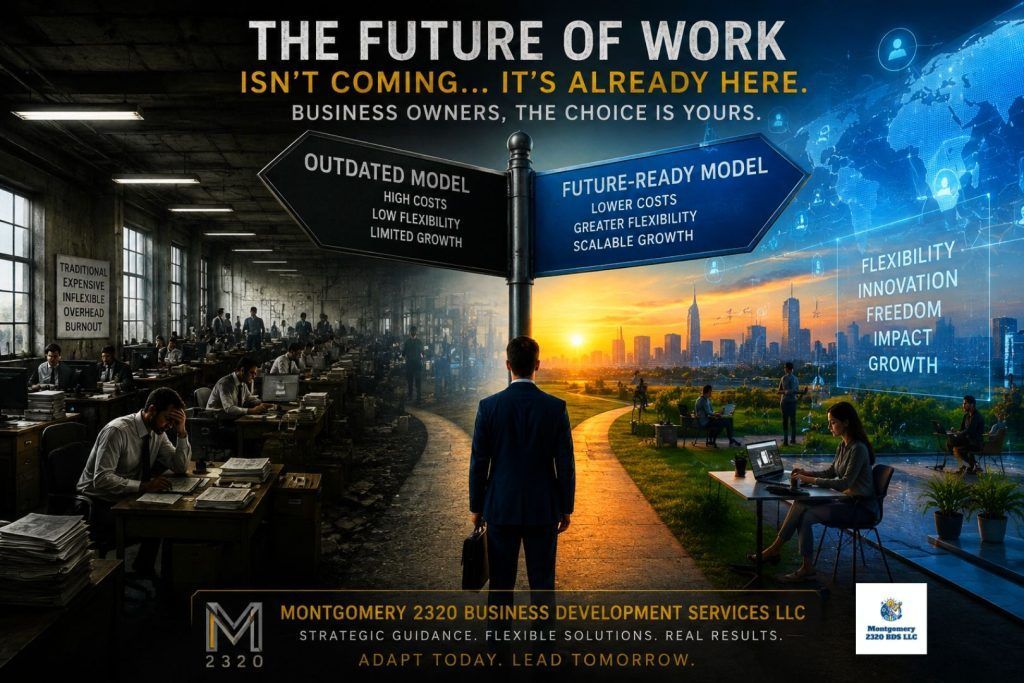
  • The Employer–Employee Relationship Is Changing Forever — And Most Businesses Are Not Prepared

    The Employer–Employee Relationship Is Changing Forever — And Most Businesses Are Not Prepared

    The Employer–Employee Relationship Is Changing Forever — And Most Businesses Are Not Prepared
#BusinessDevelopment #Leadership #FutureOfWork #BusinessStrategy #Entrepreneurship #ArtificialIntelligence #Operations #EconomicTrends #Consulting #SmallBusiness #Innovation #ContractWork #FutureBusiness #ExecutiveLeadership
    “Montgomery 2320 is the structure builder for your business”

    By Montgomery 2320 Business Development Services | 5●27●2026

    Business owners need to confront a difficult reality:

    The traditional labor model that built much of modern corporate America is undergoing a permanent transformation.

    For decades, success was measured by the size of your workforce, the number of departments you operated internally, and the amount of labor you could manage under one roof. Large employee structures were viewed as signs of stability, strength, and growth.

    Today, those same structures are increasingly becoming operational liabilities.

    The economics of labor have changed.

    Rising benefit costs, wage pressures, declining productivity ratios, burnout, workforce disengagement, compliance burdens, rapid technological advancement, and AI-assisted operational systems are forcing companies to rethink how work is performed and who performs it.

    This is not political.
    It is not emotional.
    It is economic.

    Across multiple industries, businesses are quietly shifting away from large permanent labor models and toward leaner operational ecosystems built around:
    • Contractors
    • Fractional leadership
    • Strategic consulting firms
    • AI-supported infrastructure
    • Specialized project teams
    • Outsourced execution models
    • Remote operational support systems

    Why?

    Because flexibility now carries more value than permanence.

    The market no longer rewards unnecessary operational weight.

    Many companies have discovered that hiring specialized firms on a project-by-project basis can produce faster execution, lower long-term liabilities, and greater strategic efficiency than maintaining oversized internal departments operating below full productive capacity.

    This is one of the defining business shifts of our generation.

    Yet many organizations are still operating with outdated assumptions about labor, productivity, and scalability.

    Too many businesses are trying to preserve systems designed for a different economic era while the marketplace continues accelerating toward automation, decentralized execution, and precision-based operational structures.

    The future business model is not centered around maintaining the largest workforce possible.

    The future business model is centered around:
    • Operational agility
    • Specialized expertise
    • Scalable infrastructure
    • Adaptive execution
    • Strategic partnerships
    • Intelligent cost management

    This is why firms like Montgomery 2320 Business Development Services LLC are becoming increasingly relevant in the modern economy.

    Businesses no longer simply need employees.
    They need strategic guidance, operational intelligence, flexible execution systems, and leadership capable of helping them navigate uncertainty at scale.

    The companies that understand this shift early will gain significant competitive leverage over the next decade.

    The companies that refuse to adapt may find themselves carrying labor structures and operational overhead the market no longer supports.

    Another major reality business leaders must prepare for is this:

    Many future jobs do not even exist yet.

    Think carefully about that.

    Entire generations are being trained for evolving industries while businesses simultaneously reduce dependency on traditional long-term staffing models. This creates a transition period where companies increasingly rely on contractors, consultants, strategic partnerships, automation, and temporary specialized labor to remain competitive.

    This is not fear mongering.
    This is strategic observation based on where business infrastructure is heading globally.

    The labor dynamic has changed.
    The speed of business has changed.
    The expectations of scalability have changed.

    Business owners must stop asking:
    “How do we get back to the old normal?”

    And start asking:
    “How do we build intelligently for the future that is already arriving?”

    The answer to that question may determine which businesses survive the next decade — and which ones become case studies of operational stagnation.