
By Montgomery 2320 Business Development Services | 5●27●2026
Business owners need to confront a difficult reality:
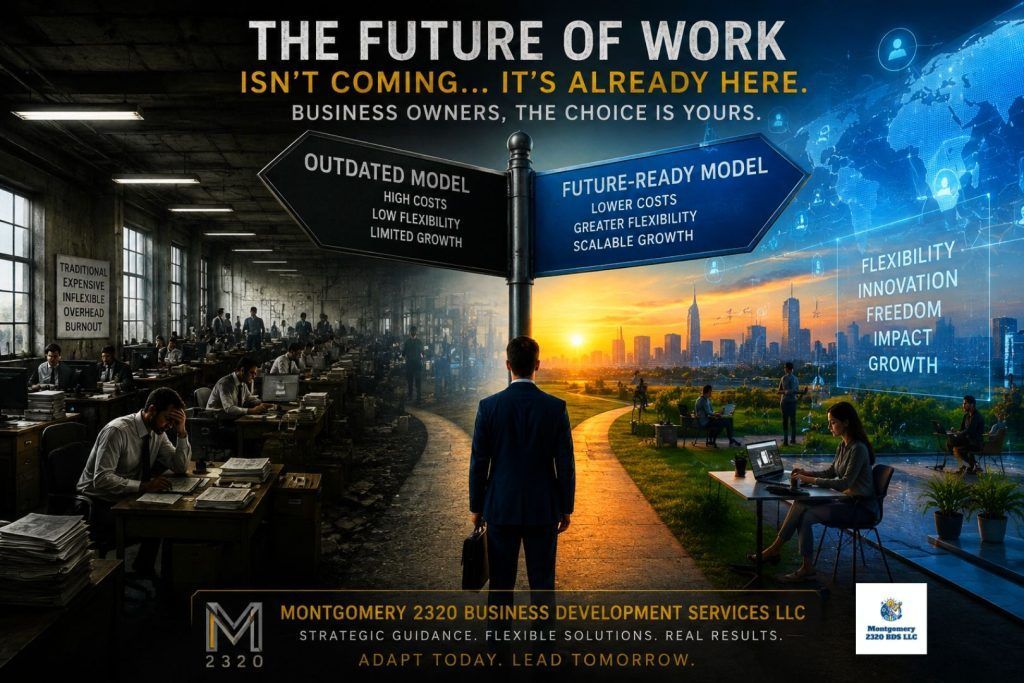
The traditional labor model that built much of modern corporate America is undergoing a permanent transformation.
For decades, success was measured by the size of your workforce, the number of departments you operated internally, and the amount of labor you could manage under one roof. Large employee structures were viewed as signs of stability, strength, and growth.
Today, those same structures are increasingly becoming operational liabilities.
The economics of labor have changed.
Rising benefit costs, wage pressures, declining productivity ratios, burnout, workforce disengagement, compliance burdens, rapid technological advancement, and AI-assisted operational systems are forcing companies to rethink how work is performed and who performs it.
This is not political.
It is not emotional.
It is economic.
Across multiple industries, businesses are quietly shifting away from large permanent labor models and toward leaner operational ecosystems built around:
• Contractors
• Fractional leadership
• Strategic consulting firms
• AI-supported infrastructure
• Specialized project teams
• Outsourced execution models
• Remote operational support systems
Why?
Because flexibility now carries more value than permanence.
The market no longer rewards unnecessary operational weight.
Many companies have discovered that hiring specialized firms on a project-by-project basis can produce faster execution, lower long-term liabilities, and greater strategic efficiency than maintaining oversized internal departments operating below full productive capacity.
This is one of the defining business shifts of our generation.
Yet many organizations are still operating with outdated assumptions about labor, productivity, and scalability.
Too many businesses are trying to preserve systems designed for a different economic era while the marketplace continues accelerating toward automation, decentralized execution, and precision-based operational structures.
The future business model is not centered around maintaining the largest workforce possible.
The future business model is centered around:
• Operational agility
• Specialized expertise
• Scalable infrastructure
• Adaptive execution
• Strategic partnerships
• Intelligent cost management
This is why firms like Montgomery 2320 Business Development Services LLC are becoming increasingly relevant in the modern economy.
Businesses no longer simply need employees.
They need strategic guidance, operational intelligence, flexible execution systems, and leadership capable of helping them navigate uncertainty at scale.
The companies that understand this shift early will gain significant competitive leverage over the next decade.
The companies that refuse to adapt may find themselves carrying labor structures and operational overhead the market no longer supports.
Another major reality business leaders must prepare for is this:
Many future jobs do not even exist yet.
Think carefully about that.
Entire generations are being trained for evolving industries while businesses simultaneously reduce dependency on traditional long-term staffing models. This creates a transition period where companies increasingly rely on contractors, consultants, strategic partnerships, automation, and temporary specialized labor to remain competitive.
This is not fear mongering.
This is strategic observation based on where business infrastructure is heading globally.
The labor dynamic has changed.
The speed of business has changed.
The expectations of scalability have changed.
Business owners must stop asking:
“How do we get back to the old normal?”
And start asking:
“How do we build intelligently for the future that is already arriving?”
The answer to that question may determine which businesses survive the next decade — and which ones become case studies of operational stagnation.
Leave a Reply